I. THE GENEVA HEALTH FILES OP-ED
Profits Over People: The High Price of Pharma’s Influence in Global Health
Lobbying Disclosures in the US: How Big Pharma Fought the TRIPS Waiver & is Pushing for Strong Intellectual Property Protection in the Pandemic Agreement
By Peter Maybarduk & Michael Weinstein
Peter Maybarduk, Director of Public Citizen’s Access to Medicines Group ([email protected]); Michael Weinstein, President of the AIDS Healthcare Foundation (Media Contact: Guilherme Faviero, AHF Global Public Health Institute, [email protected])
During the COVID-19 pandemic, the world’s 20 largest pharmaceutical companies spent nearly as much enriching shareholders as they did on research and development.
Industry giants Amgen and Novo Nordisk paid shareholder dividends that were double their R&D spending, while Novartis and AbbVie directed over $10 billion more to shareholders than to research.
As the virus swept the globe, exposing deep inequities in access to pandemic countermeasures, Global South nations struggled to secure life-saving vaccines and treatments, as high-income countries hoarded supplies, imposed export controls, and bought up most available stock. With time, we would learn that vaccine hoarding alone is estimated to have claimed over 1.3 million lives, with a disproportionate impact in low- and middle-income countries (LMICs).
Despite substantial shareholder payouts that exceeded many of its R&D budgets, the pharmaceutical lobby was hard at work to undermine global proposals aimed at promoting greater access to vaccines, therapeutics, and diagnostics in the Global South. Armed with the contested premise that such efforts would “stifle innovation,” the industry lobbied extensively against a waiver on Trade-Related Aspects of Intellectual Property Rights (TRIPS) that would have temporarily suspended World Trade Organization (WTO) intellectual property restrictions on life-saving products.
The waiver, as originally proposed by India and South Africa in October 2020, sought to temporarily suspend specific provisions of the WTO TRIPS agreement to ensure that WTO intellectual property rules did not create barriers for timely access to countermeasures to combat the pandemic. This proposal, if adopted, would have supported efforts to broaden production and address global supply gaps in vaccines, diagnostics, and treatments until widespread vaccination became available. While the waiver by itself would not have been a complete solution to the issue of access, it would have made a meaningful contribution by removing trade barriers to critical countermeasures during the worst health emergency in over a hundred years. It would have also signaled essential global cooperation in the fight against the hoarding of pandemic-related health products, and what has been called as the vaccine apartheid.
Despite support by nearly 100 developing nations, and more than 170 former heads of government and Nobel laureates, the waiver faced significant opposition from some wealthy nations. Subject to intense lobbying efforts by the pharmaceutical industry, many high-income countries – including the UK, members of the EU, and initially the United States – sought to delay the proposal through stalling tactics stretching over an astounding 18 months, until the waiver was dead in the water. All of this occurring during a critical period of the worst global health crisis in recent memory, when swift action on all fronts was vital to addressing inequities and saving lives.
New Public Citizen research shows that, in the US alone, corporations, trade groups, and other organizations deployed more than 500 lobbyists during the COVID-19 emergency to shape the US government’s global position on intellectual property, with nearly 90 percent of these lobbyists opposing the TRIPS waiver.
In Europe, where a substantial portion of many nations’ economies comes from the pharmaceutical industry, the Corporate Europe Observatory revealed that, as of 2021, over 40 pharmaceutical companies reported spending an estimated €25.3 million annually on lobbying while deploying 290 lobbyists to influence EU policies. A spokesperson from Janssen, the pharmaceutical research and development subsidiary that developed Johnson & Johnson’s single-shot vaccine, went even further by allegedly threatening the Belgian Prime Minister’s office that the company would reconsider their investments in the country if Belgium backed the waiver.
(Also see: A STOP AIDS report based on investigations in Europe: Access Denied – What happens when Big Pharma is in the driving seat)
While the US would shift its stance and eventually support a narrow waiver limited only to vaccines, adopted through the WTO’s Ministerial Decision on June 17, 2022, Big Pharma’s efforts had already paid off as the implementation of any waiver was significantly delayed and its scope substantially narrowed.
Despite being rebooted in Geneva this past September, negotiations have not broken through critical disagreements that exist along the North-South divide on how to address critical areas for equity, including the proposed Pathogen Access and Benefits Sharing System (PABS), and provisions on the transfer of technology and know-how for the production of pandemic-related health products. High-income countries continue to oppose meaningful advances on PABS and to push for binding provisions that would define technology transfer in terms of “voluntary” and “mutually agreed terms” – a preferred industry position that is being defended strongly by mostly developed countries, and other Geneva-based actors.
Even though many wealthy nations have at their disposal broad legal and regulatory tools to compel the industry to share technology and know-how through non-voluntary means, the hypocrisy of fighting for language that could deter LMICs from doing the same, cannot be overstated. Furthermore, some of these rich countries also oppose the inclusion of a «peace clause» that would reaffirm a collective commitment by signatories to refrain from «any direct or indirect pressure» to discourage the use of TRIPS and other flexibilities under Article 9 – a provision related to research and development.
Considering the complexities of these global negotiations among countries with vastly different capabilities and circumstances, it is easy to lose sight of the damaging influence the pharmaceutical lobby has had on the process. However, the fundamental issue standing in the way of the grand bargain that can prevent deadly outbreaks and make available medical tools to fight them, is whether wealthy nations are prepared to break steps with the pharmaceutical industry and say “no” to insatiable greed and corporate interests.
Drugmakers and other actors, have a financial interest in keeping medical tools and knowledge proprietary, only sharing these strictly on their own terms—even during global catastrophes—and they are doing all they can to protect their ability to profit without being burdened by concerns over equity.
II. GHF PUBLICATION: SEPTEMBER 2024
A blow-by-blow account of the highly political and contentious negotiations around the TRIPS Waiver proposal at the World Trade Organization (WTO) between October 2020 and March 2024.
The protracted, but unsuccessful negotiations show how the WTO failed in addressing the challenges of COVID-19 that resulted in more than 15 million associated deaths due to the pandemic. So while the “TRIPS Waiver” failed to become a trade policy option at the WTO in the context of health emergencies, it undoubtedly reset the debate on the role of IP in global health.
This newly updated book is a compilation of nearly 70 stories that chronicle these negotiations between 2020-2024 published in the Geneva Health Files during this period.
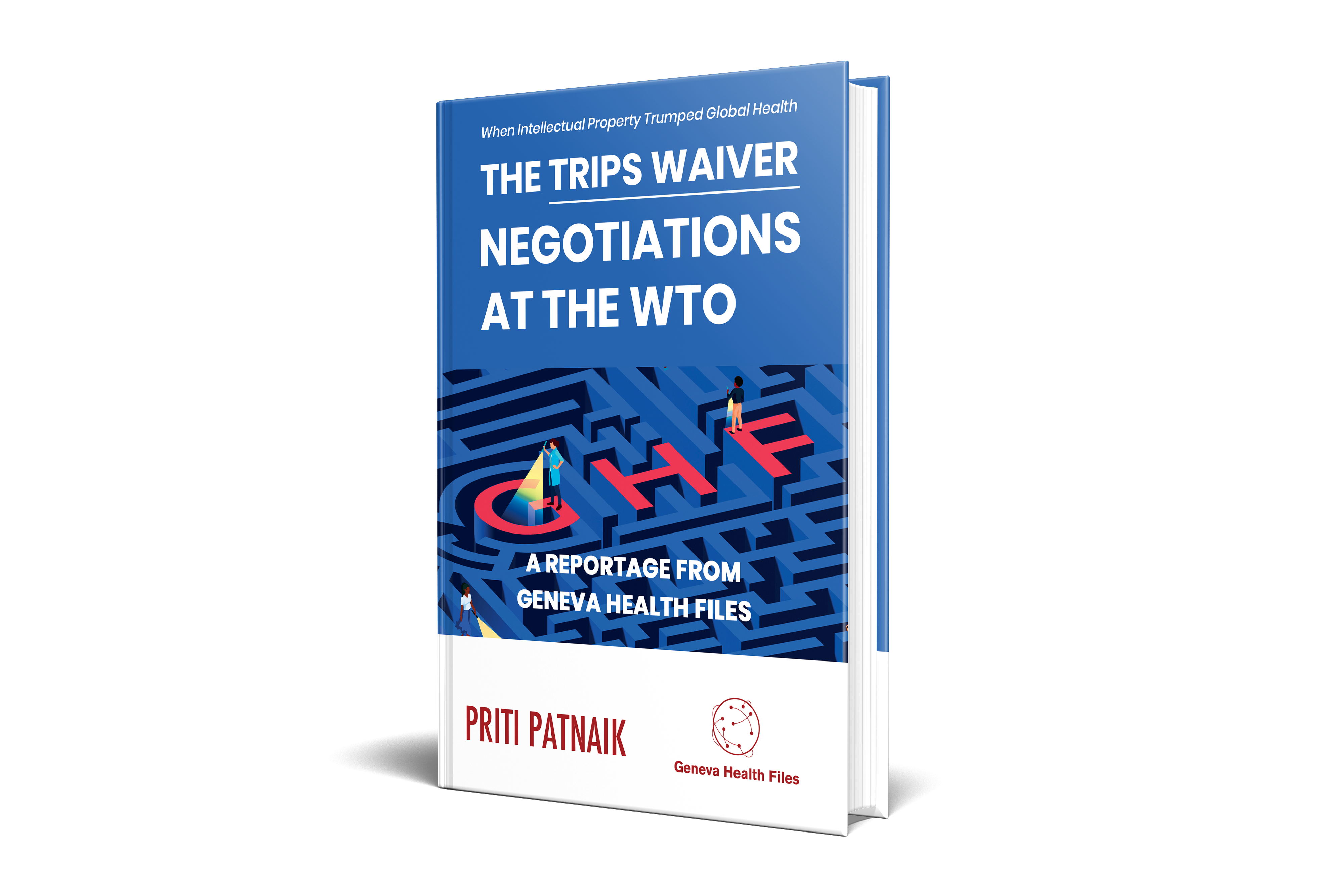
The TRIPS Waiver Negotiations at the WTO: When Intellectual Property Trumped Global Health
[ISBN: 9782970162728] Buy here.